Canadian-led Nature study reveals ancient, unusually hot galaxy cluster SPT2349-56
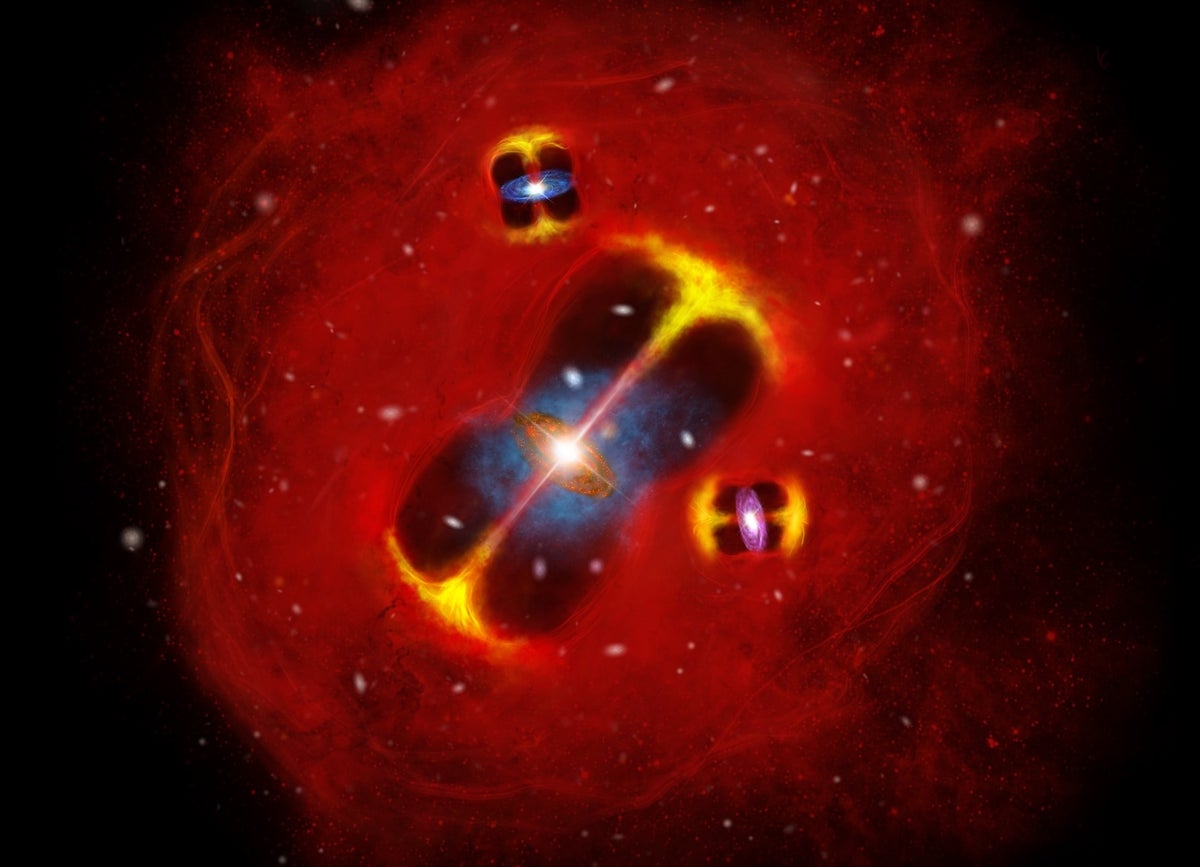
A Canadian-led Nature study reveals SPT2349-56, a 12-billion-year-old, unusually hot 'baby' cluster of 30+ galaxies forming stars 5,000 times the Milky Way, challenging early models.
 Scientific American
Stunningly Hot Galaxy Cluster Puts New Spin on How These Cosmic Behemoths Evolved
Scientific AmericanStunningly Hot Galaxy Cluster Puts New Spin on How These Cosmic Behemoths Evolved

 The Debrief
An Anomalous Galaxy Cluster “Too Strong to be Real” is So Hot It's Breaking Existing Models
The DebriefAn Anomalous Galaxy Cluster “Too Strong to be Real” is So Hot It's Breaking Existing Models
Overview
A Canadian-led international team published new observations in Nature documenting SPT2349-56, a distant 'baby' galaxy cluster whose light began its journey roughly 12 billion years ago.
The compact cluster hosts over 30 actively star-forming galaxies crammed into a small region, collectively producing stars at roughly 5,000 times the Milky Way's present star-formation rate.
Observations indicate the cluster is unusually hot for its age, emitting high-energy signals that indicate heating mechanisms beyond standard early-universe thermal models.
The cluster's temperature and rapid starburst activity challenge existing theoretical frameworks for early galaxy cluster formation, prompting calls for revised simulations and physical explanations.
Authors propose deeper multiwavelength observations and model revisions to probe heating sources, starburst triggers, and how such massive, hot structures assembled within the first two billion years.
Analysis
Center-leaning sources present this story with a neutral tone, focusing on the scientific discovery and its implications without using loaded language or selective emphasis. The article provides balanced coverage by including direct quotes from researchers, explaining the scientific methods used, and discussing the broader impact on existing models. This approach ensures a comprehensive understanding of the discovery's significance without editorial bias.